
How Did the ‘Secret’ Sykes-Picot Agreement Become Public?
Soon after coming to power, the Bolsheviks printed the text in Pravda—not the last time the Russians would play spoiler to Western efforts to control events in Syria and Iraq.
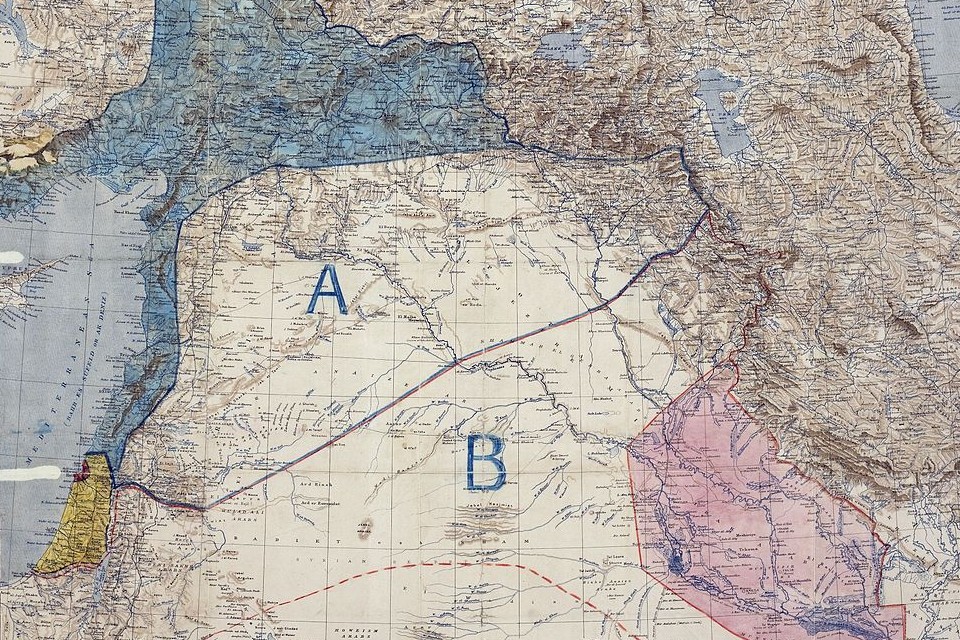
But wait a second: secret agreement? How did a confidential document become a hotly contested matter of the public record not long after it was signed? The answer is a tale of intrigue that serves as a reminder of how unstable closed-door diplomacy is, and how fast quiet handshakes can cause public backlash, even in the age before Wikileaks.
European governments had long viewed Ottoman Empire as weak. But the French and British, the Ottomans’ opponents in World War I, decided the empire couldn’t outlast the war, and in 1915 moved toward splitting up the Levantine territories under Ottoman control. Sykes and Georges-Picot were charged with figuring out how. The agreement they came to—with the assent of their ally Russia—granted Russian control over present-day eastern Turkey. The French would influence or control southern Turkey, Lebanon, present-day Syria, and Northern Iraq. The British would dominate a corridor running from Egypt west through the Negev Desert, present-day Jordan, and most of what is now Iraq and Kuwait. Present-day northern Israel and the West Bank would become an international zone, though Britain would control the port of Haifa.

The agreement was concluded in secret partly because it represented a betrayal of promises the British government had already made to Hussein bin Ali, the sharif of Mecca. During the war, in an effort to foment an Arab rebellion against the Ottomans, the British sought Hussein’s support by agreeing to back the creation of an independent Arab state, with a few caveats. In what is known as the McMahon-Hussein Correspondence, Britain laid out the conditions: It wanted to maintain rights in Baghdad and Basra, and it wanted to set aside pieces of present-day Syria, which it said were not fully Arab. The Arabs duly revolted against the Ottomans, with the help of the British military officer T.E. Lawrence. But after the war, the British would maintain that the correspondence did not represent a formal treaty, though Hussein and his family insisted it did. In any case, the promises made to Hussein were in irreconcilable conflict with the Sykes-Picot Agreement.
A further British promise incompatible with Sykes-Picot came later, on November 2, 1917, when U.K. Foreign Secretary Arthur James Balfour wrote to British Jewish leader Walter Rothschild, stating that the British government viewed “with favour the establishment in Palestine of a national home for the Jewish people, and will use their best endeavours to facilitate the achievement of this object.” That seemed in conflict with the international zone Sykes-Picot envisioned in the Levant.
The extent to which Sykes-Picot remained in force even at the time is a matter of debate. Once the agreement was revealed, Britain and France scrambled to contain the fallout. In 1918, the Anglo-French Declaration decreed support for “indigenous Governments and administrations in Syria and Mesopotamia.” The international mandate system set up by the League of Nations to govern formerly Ottoman territories also superseded the agreement—though the outlines of those mandates roughly coincided with those set out in Sykes-Picot.
Dead and buried or undead and haunting the Middle East today, the Sykes-Picot Agreement has echoes that still resonate. Despite the controversy when the text was revealed, the British and French were not deterred from signing another secret agreement in 1956, five years after Georges-Picot’s death. That deal, which also included Israel, set in motion a plot to topple Egyptian President Gamal Abdel Nasser over his seizure of the Suez Canal. The British, French, and Israelis were militarily successful in ensuing war but were forced to retreat under pressure from the Americans and—who else?—the Soviet Union. The secret protocol was revealed, and U.K. Prime Minister Anthony Eden was forced to resign.
Today, the United Kingdom and United States governments, along with a cast of allies, are trying to contain ISIS in Iraq and Syria, while also eventually bringing about the end of Syrian President Bashar al-Assad’s regime. It’s a complicated process, involving both public and secret diplomacy, as well as military operations both covert and announced. But those efforts have been confounded by the intervention of Russia, which has staunchly backed Assad and attacked rebel groups allied with the U.S. and U.K. Lazy commentators like to trace Middle East strife to the spurious explanation of “ancient hatreds,” ethnic and sectarian conflicts running back centuries in the region. As Russia’s continuing role in confounding Anglo-American efforts shows, however, one of the most intractable geopolitical conflicts in the Levant is just turning 100 this year.
Comments
Post a Comment